FB most commonly means Facebook in text messages and on social media. People use it as a short abbreviation when talking about the platform sharing profiles discussing posts or referring to Messenger conversations.
You’ll often see FB on TikTok Snapchat Instagram WhatsApp and in regular text messages. Since internet slang changes quickly many people search for its meaning to make sure they’re interpreting messages correctly.
Although FB almost always stands for Facebook its meaning can vary slightly depending on the conversation. Understanding the context helps you know exactly what someone is referring to.
In this guide, you’ll learn what FB means where people use it, real chat examples how to reply and whether it’s appropriate in different situations.
FB Meaning in Text
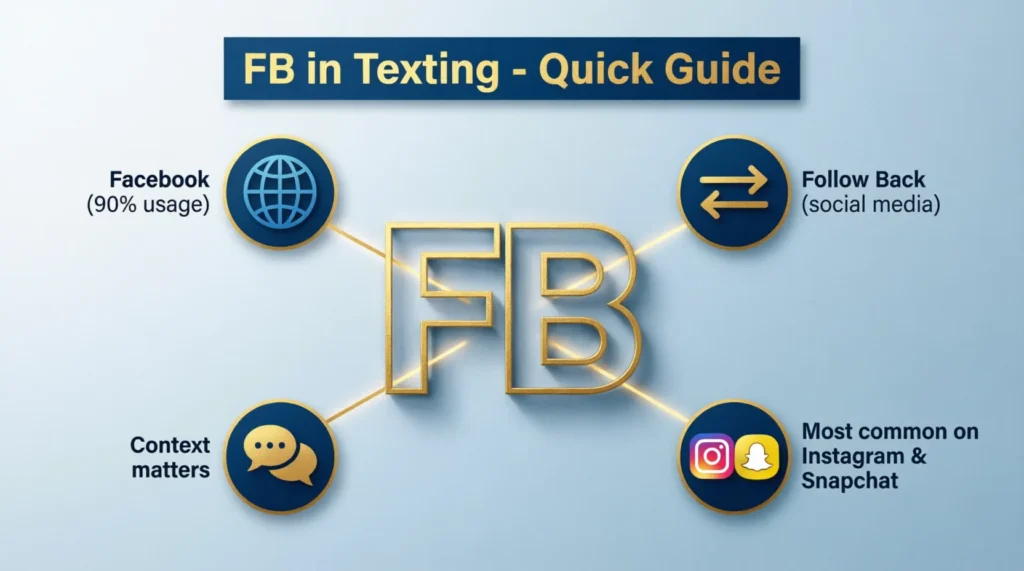
The abbreviation FB simply stands for Facebook.
It is an abbreviation, not internet slang in the traditional sense. Instead of typing the full word, people shorten it to FB because it’s faster and easier, especially while texting.
For example:
- “I saw it on FB.”
- “Add me on FB.”
- “Check your FB messages.”
In everyday conversations, FB usually refers to:
- The Facebook app
- A Facebook profile
- Facebook Messenger
- A Facebook post, page, or group
Most people immediately understand FB because it has been widely used online for many years.
Where People Use FB
FB on TikTok
TikTok creators often mention FB when directing viewers to another platform.
Examples include:
- “Full video is on FB.”
- “Join our FB community.”
- “Follow us on FB.”
Many businesses and creators use TikTok to attract viewers while encouraging them to visit their Facebook pages.
FB on Snapchat
Snapchat users sometimes exchange social media accounts.
Examples:
- “What’s your FB?”
- “I’ll message you on FB.”
Although Snapchat is mainly used for photos and chats, some people still connect through Facebook.
FB on Instagram
Instagram users frequently mention FB because both platforms belong to the same company.
Examples:
- “Shared from FB.”
- “Find more updates on our FB page.”
Businesses often cross-post their content between Instagram and Facebook.
FB on WhatsApp
People commonly use FB when discussing social media.
For example:
- “Did you see my FB post?”
- “I found it on FB yesterday.”
Since WhatsApp is used for private conversations, FB often appears when talking about something shared publicly.
FB in SMS Text Messages
Traditional texting also uses FB.
Examples include:
- “Send me your FB profile.”
- “Are you still using FB?”
Typing FB saves time while keeping the message clear.
Real Chat Examples
Example 1
A: Did you post the vacation pictures?
B: Yes, they’re on FB.
A: I’ll check them tonight.
Example 2
A: Can you send me the event details?
B: They’re on our FB page.
A: Thanks!
Example 3
A: What’s your FB?
B: I’ll send you the link.
A: Great.
Example 4
A: I saw your new profile picture.
B: On FB?
A: Yep!
Example 5
A: Did you read the announcement?
B: Only on FB.
A: I’ll look now.
Example 6
A: Where did you find that recipe?
B: Someone shared it on FB.
A: Nice!
Example 7
A: Are you still active on FB?
B: Sometimes.
A: Same here.
Example 8
A: Did Grandma see the photos?
B: Yes, she commented on FB.
A: That’s sweet.
Example 9
A: Where’s the livestream?
B: It’s on FB tonight.
A: I’ll join.
Example 10
A: How did you hear about the sale?
B: Through FB.
A: Good catch!
How to Reply When Someone Says “FB”
Your reply depends on the conversation.
Funny Replies
- Facebook still exists?
- I’ll dust off my account.
- Time to remember my password!
Casual Replies
- I’ll check it.
- Thanks for letting me know.
- I’ll look on FB later.
Friendly Replies
- Send me your profile.
- I’ll follow your page.
- Thanks for sharing it.
Neutral Replies
- Got it.
- Okay.
- I’ll have a look.
- Thanks.
Is FB Rude or Offensive?
No.
FB is not rude or offensive. It is simply a common abbreviation for Facebook.
It is safe to use in:
- Text messages
- Social media
- Online discussions
- Casual conversations
In professional emails or formal business writing, it’s usually better to write Facebook instead of using FB, especially the first time you mention it.
In schools and workplaces, FB is generally acceptable when discussing the platform itself.
Who Uses This Term?
People of all ages use FB, although usage has changed over time.
Teenagers
Teenagers understand the abbreviation but may spend more time on TikTok or Snapchat than Facebook itself.
Gen Z
Gen Z recognizes FB even if they don’t use Facebook every day. They often mention it when referring to family groups, Marketplace, or community pages.
Millennials
Millennials are among the most frequent users of the abbreviation because many actively use Facebook for personal and professional networking.
Older Adults
Many older adults use FB regularly and often type the abbreviation while texting friends and family.
Overall, FB remains one of the most recognized internet abbreviations worldwide.
Origin of the Term
FB appeared shortly after Facebook became one of the world’s largest social networking websites.
As texting became more popular, users naturally shortened Facebook to FB to save time.
Unlike many internet slang terms, FB has a very straightforward origin. It wasn’t created as a joke or hidden code—it simply became a convenient abbreviation.
Its popularity grew through:
- SMS texting
- Online forums
- Social media
- Instant messaging
- Internet culture
Today, FB is understood almost everywhere online.
Comparison Table
| Term | Meaning | Type | Usage | Popularity |
|---|---|---|---|---|
| FB | Abbreviation | Referring to Facebook | Very High | |
| IDK | I Don’t Know | Acronym | Expressing uncertainty | Very High |
| IDC | I Don’t Care | Acronym | Showing indifference | High |
| IMO | In My Opinion | Acronym | Sharing opinions | High |
| BRB | Be Right Back | Acronym | Temporary absence | Very High |
Real World Usage Example
Imagine your friend tells you about a local community event.
Instead of sending every detail through text, they simply say:
“The schedule is on our FB page.”
You visit the Facebook page, where you find the event time, location, photos, and updates. In this situation, using FB makes the conversation shorter while everyone still understands what platform is being discussed.
Different Meanings of FB Depending on Context
Although FB usually means Facebook, the abbreviation can have different meanings in specific situations. Context is the key to understanding what someone is talking about.
For example, in business conversations, FB might refer to “Feedback.” In gaming communities, it can sometimes stand for “Flashback” or another game-specific term. In sports, a coach may use FB to mean “Fullback.”
However, when you’re chatting with friends or browsing social media, FB almost always refers to Facebook.
Here are a few examples:
- “I found it on FB.” → Facebook
- “Can you give me your FB?” → Facebook profile
- “Thanks for the FB.” → Feedback (work or school)
- “Our FB scored a touchdown.” → Fullback (football)
Always read the surrounding message before deciding what FB means.
Why Do People Say FB Instead of Facebook?
People shorten words because it’s quicker and easier while typing.
Just as people write “DM” instead of “Direct Message,” they often type FB instead of Facebook.
Some reasons include:
- Faster texting
- Saves typing time
- Common internet habit
- Easy to recognize
- Fits short social media comments
Although smartphones have improved typing speed, abbreviations remain popular because they’re convenient.
Common Situations Where You’ll See FB
You might encounter FB in many everyday situations online.
Some common examples include:
- Sharing Facebook posts
- Asking for someone’s profile
- Discussing Marketplace listings
- Joining Facebook groups
- Referring to Messenger chats
- Talking about business pages
- Event invitations
- Community announcements
Because Facebook offers many features, FB appears in a wide variety of conversations.
Examples of FB Used in Complete Sentences
Seeing the abbreviation inside full sentences makes it easier to understand.
Examples:
- I uploaded our family photos to FB.
- She invited everyone through FB.
- Our school announced the holiday on FB.
- Check FB for today’s live stream.
- He sells handmade products on FB Marketplace.
- I forgot my FB password.
- We met through an FB group.
- That video went viral on FB.
- My aunt shares recipes on FB every day.
- I’ll send the event link through FB.
FB in Business and Marketing
Businesses frequently use FB when discussing digital marketing.
For example:
- FB Ads
- FB Business Page
- FB Groups
- FB Marketplace
- FB Live
Companies often advertise products, answer customer questions, and build online communities through Facebook.
Marketing professionals commonly use the abbreviation in meetings, reports, and social media planning.
FB vs Facebook: Is There Any Difference?
No.
FB and Facebook mean the same thing.
The only difference is that FB is simply a shortened version.
People usually write:
- FB in text messages
- Facebook in articles
- FB in quick chats
- Facebook in formal writing
Both refer to the same social media platform.
Mistakes People Make About FB
Many beginners assume every internet abbreviation has multiple hidden meanings.
With FB, that’s usually not true.
Common misunderstandings include:
- Thinking FB is internet slang
- Assuming it has a secret meaning
- Confusing it with Messenger
- Believing it means “Follow Back”
In most conversations, FB simply means Facebook.
Similar Internet Abbreviations You Should Know
Learning related abbreviations makes online conversations much easier.
Some of the most common include:
- DM — Direct Message
- PM — Private Message
- IG — Instagram
- TT — TikTok
- YT — YouTube
- X — X (formerly Twitter)
- IMO — In My Opinion
- BTW — By The Way
- TTYL — Talk To You Later
- LOL — Laughing Out Loud
These abbreviations appear regularly across social media platforms.
Can FB Have More Than One Meaning?
Yes, but only in certain industries or topics.
Examples include:
| Meaning | Used In |
|---|---|
| Social media | |
| Feedback | School and business |
| Fullback | American football |
| Flashback | Gaming and entertainment |
If someone says, “Check my FB post,” there’s little doubt they mean Facebook.
If someone says, “Great FB on my presentation,” they mean feedback instead.
Tips for Understanding Internet Abbreviations
If you’re unsure what an abbreviation means, don’t panic.
Try these simple tips:
- Read the entire conversation.
- Look at the platform where it’s used.
- Think about the topic being discussed.
- Ask the sender politely if you’re still unsure.
- Search the abbreviation if needed.
Context usually provides the correct meaning within seconds.
Final Tips Before Using FB
Before using FB in your own messages, remember these simple guidelines:
- Use FB in casual conversations.
- Write Facebook in formal documents.
- Don’t assume everyone knows every abbreviation.
- Consider your audience before shortening words.
- When in doubt, spell out the full name.
Using abbreviations appropriately makes your communication clearer and more natural.
How FB Is Used by Different Generations
The meaning of FB stays the same, but the way people use it can vary across age groups.
Gen Z
Many Gen Z users recognize FB even if they rarely post on Facebook. They are more likely to mention it when talking about family groups, Marketplace listings, or community events rather than personal updates.
Millennials
Millennials grew up during Facebook’s rapid rise and are still among its most active users. They commonly use FB when discussing old memories, networking, parenting groups, and local communities.
Gen X
Gen X often uses Facebook to stay connected with family, friends, and local organizations. For them, typing “FB” is simply a convenient shortcut in text messages.
Older Adults
Many older adults actively use Facebook for sharing photos, joining hobby groups, and keeping up with relatives. While some spell out “Facebook,” many also use the abbreviation FB once the topic is clear.
FB in Online Buying and Selling
One of the most common places you’ll see FB today is in online buying and selling.
Millions of people use Facebook Marketplace to buy and sell:
- Used furniture
- Electronics
- Clothing
- Cars
- Home décor
- Baby items
- Sports equipment
Example conversations:
- “I found that bike on FB.”
- “Try checking FB Marketplace.”
- “Someone on FB is selling one nearby.”
In these cases, FB refers to the marketplace feature rather than the social networking aspect of Facebook.
FB in Community Groups
Facebook is home to countless local and global communities.
People often shorten Facebook to FB when talking about groups such as:
- Neighborhood communities
- Parenting groups
- Pet owner groups
- Travel communities
- Gaming clubs
- Study groups
- Job seeker groups
- Local business communities
Example:
“I’ll ask in the FB gardening group.”
Using FB keeps conversations shorter while everyone understands the platform being discussed.
FB in News and Local Updates
Many schools, businesses, charities, and government offices maintain Facebook pages to share important information.
As a result, people frequently say things like:
- “The update is on FB.”
- “Check the school’s FB page.”
- “Our town posted it on FB.”
This is especially common for:
- Holiday announcements
- Weather alerts
- Event schedules
- Office closures
- Community notices
FB for Events and Invitations
Facebook Events remains a popular way to organize gatherings.
Instead of sending individual invitations, hosts often create an event page and tell friends:
- “RSVP on FB.”
- “The event details are on FB.”
- “I invited everyone through FB.”
The event page usually contains:
- Date
- Time
- Location
- Guest list
- Photos
- Updates
When You Should Spell Out “Facebook”
Although FB is widely understood, there are situations where writing the full word is the better choice.
Use Facebook instead of FB when:
- Writing blog articles
- Creating business reports
- Publishing academic work
- Preparing presentations
- Writing official emails
- Explaining social media to beginners
Using the complete word improves clarity for readers who may not recognize abbreviations.
FB in Customer Support Conversations
Businesses often use Facebook as a customer support channel.
For example:
- “Please contact us on FB Messenger.”
- “Send your order number through FB.”
- “Our support team will reply on FB.”
Customers also use FB when discussing their experiences:
- “I messaged them on FB.”
- “Their FB team replied quickly.”
- “I contacted customer service through FB.”
Common Questions People Ask About FB
People often search for FB because they’re unsure how it’s being used in a message.
Some common questions include:
- Does FB always mean Facebook?
- Is FB different from Messenger?
- Why do people type FB instead of Facebook?
- Can FB have multiple meanings?
- Is FB still commonly used today?
- Should I write FB in professional communication?
These questions usually arise because abbreviations can change depending on the conversation.
Benefits of Using FB as an Abbreviation
There are several reasons why people continue using FB.
It Saves Time
Typing two letters is much faster than writing the full platform name.
Everyone Recognizes It
Because Facebook has existed for many years, FB is familiar to most internet users.
It Keeps Messages Short
Shorter messages are easier to read, especially during fast conversations.
It Works Across Platforms
Whether you’re texting, using WhatsApp, or commenting on Instagram, FB is widely understood.
Does FB Mean the Same Around the World?
Yes, in most English-speaking conversations, FB almost always refers to Facebook regardless of the country.
You’ll find people using the abbreviation in:
- United States
- United Kingdom
- Canada
- Australia
- India
- Pakistan
- Philippines
- South Africa
Although language and slang differ across regions, FB has become a nearly universal abbreviation for Facebook.
Internet Etiquette When Using FB
Using abbreviations is helpful, but good communication still matters.
Here are a few etiquette tips:
- Make sure your audience understands the abbreviation.
- Avoid overusing abbreviations in professional settings.
- If you’re talking to someone unfamiliar with social media, write “Facebook” instead.
- Keep your message clear and easy to understand.
- Don’t assume every abbreviation is universally known.
Simple communication helps avoid misunderstandings.
The Future of the FB Abbreviation
Social media trends change every year, but FB is likely to remain a familiar abbreviation for a long time.
Even though many younger users spend more time on newer platforms, Facebook continues to be widely used for:
- Local communities
- Marketplace
- Family communication
- Business pages
- Public events
- Interest groups
As long as Facebook remains popular, the abbreviation FB will continue to appear in text messages and online conversations.
FB in Facebook Messenger
Many people use FB when they’re specifically talking about Facebook Messenger, even if they don’t mention the word “Messenger.”
For example:
- “I sent it on FB.”
- “Check your FB messages.”
- “Reply to me on FB.”
In these cases, the person is referring to Messenger because it is connected to Facebook.
This shortcut is especially common among friends and family who regularly communicate through the platform.
FB for Personal vs. Professional Use
Facebook serves different purposes depending on the user.
Personal Use
Individuals use FB to:
- Share life updates
- Upload photos and videos
- Stay connected with family
- Celebrate birthdays
- Join hobby groups
- Chat with friends
Professional Use
Businesses and professionals use FB to:
- Promote products
- Run advertising campaigns
- Answer customer questions
- Share company news
- Build online communities
- Recruit employees
Because Facebook supports both personal and business activities, the abbreviation FB appears in many different conversations.
How FB Helps Businesses Reach Customers
Small and large businesses continue to use Facebook because it offers several tools for connecting with customers.
Some of these include:
Business Pages
Companies can create public pages where they share updates, promotions, and announcements.
Facebook Ads
Businesses use paid advertisements to reach people based on their interests, location, and demographics.
Messenger Support
Customers often contact businesses through Messenger for quick assistance.
Community Engagement
Many brands build loyal audiences by posting helpful content and interacting with followers.
When marketers discuss these features, they often shorten Facebook to FB.
FB in Educational Communities
Schools, colleges, and educational organizations frequently use Facebook to communicate with students and parents.
Examples include:
- Homework reminders
- School announcements
- Alumni groups
- Study discussions
- Club activities
- Event updates
Students may send messages like:
- “The notes are on the class FB group.”
- “Our teacher posted it on FB.”
In these cases, FB helps students quickly identify where important information is available.
FB in Nonprofit Organizations
Many charities and nonprofit organizations rely on Facebook to spread awareness.
Common uses include:
- Fundraising campaigns
- Volunteer recruitment
- Event promotion
- Donation announcements
- Community outreach
Supporters often say:
- “I saw the fundraiser on FB.”
- “Share it on FB so more people can help.”
The abbreviation makes conversations about online campaigns shorter and easier.
Why FB Is Easy to Recognize
Not every internet abbreviation becomes widely understood, but FB has remained recognizable for years.
Several factors contribute to this:
- Facebook is one of the world’s most well-known websites.
- The abbreviation is short and memorable.
- It has been used since the early days of social media.
- News outlets, businesses, and individuals all use it.
- It appears in millions of online conversations every day.
Even people who rarely use Facebook usually understand what FB means.
How Context Changes the Meaning of FB
Although FB usually stands for Facebook, context determines its exact meaning.
Consider these examples:
“I posted it on FB.”
Here, FB refers to the Facebook platform.
“Our FB page reached 10,000 followers.”
In this sentence, FB specifically means a Facebook business page.
“Join our FB group.”
Now FB refers to a Facebook Group.
“Message me on FB.”
Here, the speaker means Facebook Messenger.
The abbreviation stays the same, but the specific feature changes based on the conversation.
Signs That FB Means Facebook
If you’re unsure about the abbreviation, look for nearby words that provide clues.
FB almost certainly means Facebook when you see words like:
- Post
- Profile
- Friend request
- Messenger
- Marketplace
- Group
- Like
- Comment
- Share
- Live
- Page
- Story
- Account
These related terms help identify the intended meaning without confusion.
Similar Abbreviations Used for Social Media Platforms
Many popular platforms are commonly shortened in everyday conversations.
| Abbreviation | Full Name | Common Use |
|---|---|---|
| FB | Social networking | |
| IG | Photos and Reels | |
| TT | TikTok | Short-form videos |
| YT | YouTube | Video sharing |
| LI | Professional networking | |
| SC | Snapchat | Photo messaging |
| X | X (formerly Twitter) | Microblogging |
| WA | Instant messaging |
Learning these abbreviations makes online communication much easier.
How New Internet Users Can Understand FB Faster
If you’re new to texting or social media, internet abbreviations can feel confusing at first.
A simple strategy is to:
- Read the entire conversation.
- Identify the topic.
- Notice which app is being discussed.
- Look for related words like “page” or “profile.”
- Ask for clarification if necessary.
With practice, recognizing abbreviations like FB becomes second nature.
Why Beginners Often Confuse FB
People who are new to online conversations sometimes assume every abbreviation has a hidden meaning.
Some common beginner mistakes include:
- Thinking FB is a secret slang term.
- Confusing FB with “Follow Back.”
- Assuming FB always refers to Messenger.
- Believing FB has different meanings on every platform.
In reality, most casual conversations use FB simply as a short form of Facebook.
Quick Facts About FB
Here are a few interesting facts about the abbreviation:
- FB is only two letters long, making it one of the shortest platform abbreviations.
- It is recognized across multiple generations.
- Businesses, schools, families, and communities all use it.
- It appears in casual texts, comments, and online discussions.
- It is one of the oldest and most stable social media abbreviations still in regular use.
These facts explain why FB continues to appear so frequently across the internet.
Frequently Asked Questions
What does FB mean in text messages?
FB usually means Facebook. It’s a short abbreviation people use instead of typing the full word.
What does FB mean on TikTok?
On TikTok, FB almost always refers to Facebook. Creators often direct viewers to their Facebook pages for more content.
Is FB slang?
Not exactly. FB is an abbreviation rather than traditional internet slang.
Is FB rude or offensive?
No. FB is a neutral abbreviation and is safe to use in most casual conversations.
How should you reply to FB?
A simple reply like “I’ll check it,” “Thanks,” or “Send me the link” usually works, depending on the conversation.
Conclusion
FB simply means Facebook, and it’s one of the most common abbreviations used in online conversations. Whether you’re texting a friend, chatting on WhatsApp, browsing TikTok, or commenting on Instagram, you’ll likely come across this short form.
Most of the time, FB refers to the Facebook platform, a Facebook page, a profile, or content shared there. It’s a friendly, widely recognized abbreviation that helps people communicate more quickly.
While FB is perfectly acceptable in casual conversations and social media, writing the full word “Facebook” is usually a better choice in formal emails or professional documents. Knowing the meaning of FB makes it easier to follow online conversations and communicate with confidence.

Emma is a language enthusiast and content writer with over 5 years of experience in grammar, writing, and English language education. She specializes in creating clear, accurate, and easy-to-understand content that helps readers improve their communication skills. Her work focuses on grammar rules, vocabulary, punctuation, internet slang, and everyday English usage.